All posts by Kateryna Skupovska

Auditory Seminar | December 10, 2026 | Drs. Soner Türüdü

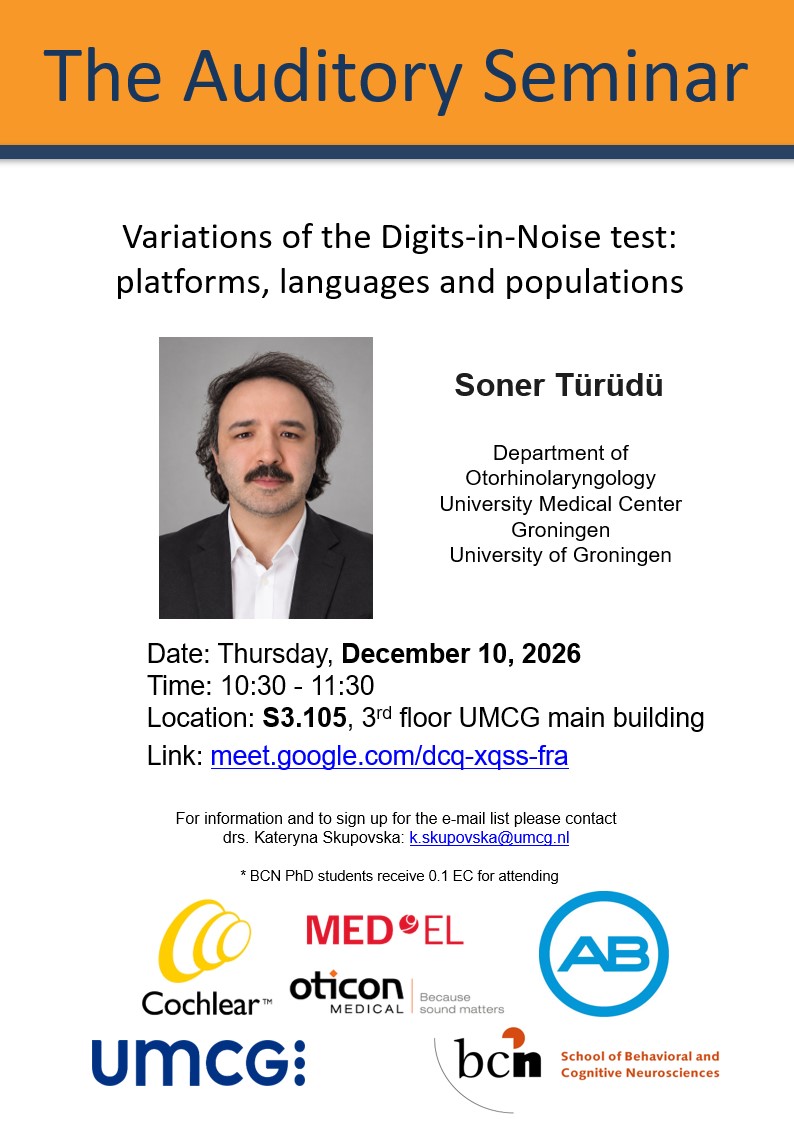
Variations of the Digits-in-Noise test: platforms, languages and populations
Drs. Soner Türüdü
Department of Otorhinolaryngology, UMCG, University of Groningen

Thursday, 10 December, 202610:30 (CEST)
S3.105, UMCG
Link for online participation: https://meet.google.com/dcq-xqss-fra

For information and to sign up for the email list, please contact drs. Kateryna Skupovska, k.skupovska@rug.nl


Soner Türüdü will defend his PhD on 10 December 2026!

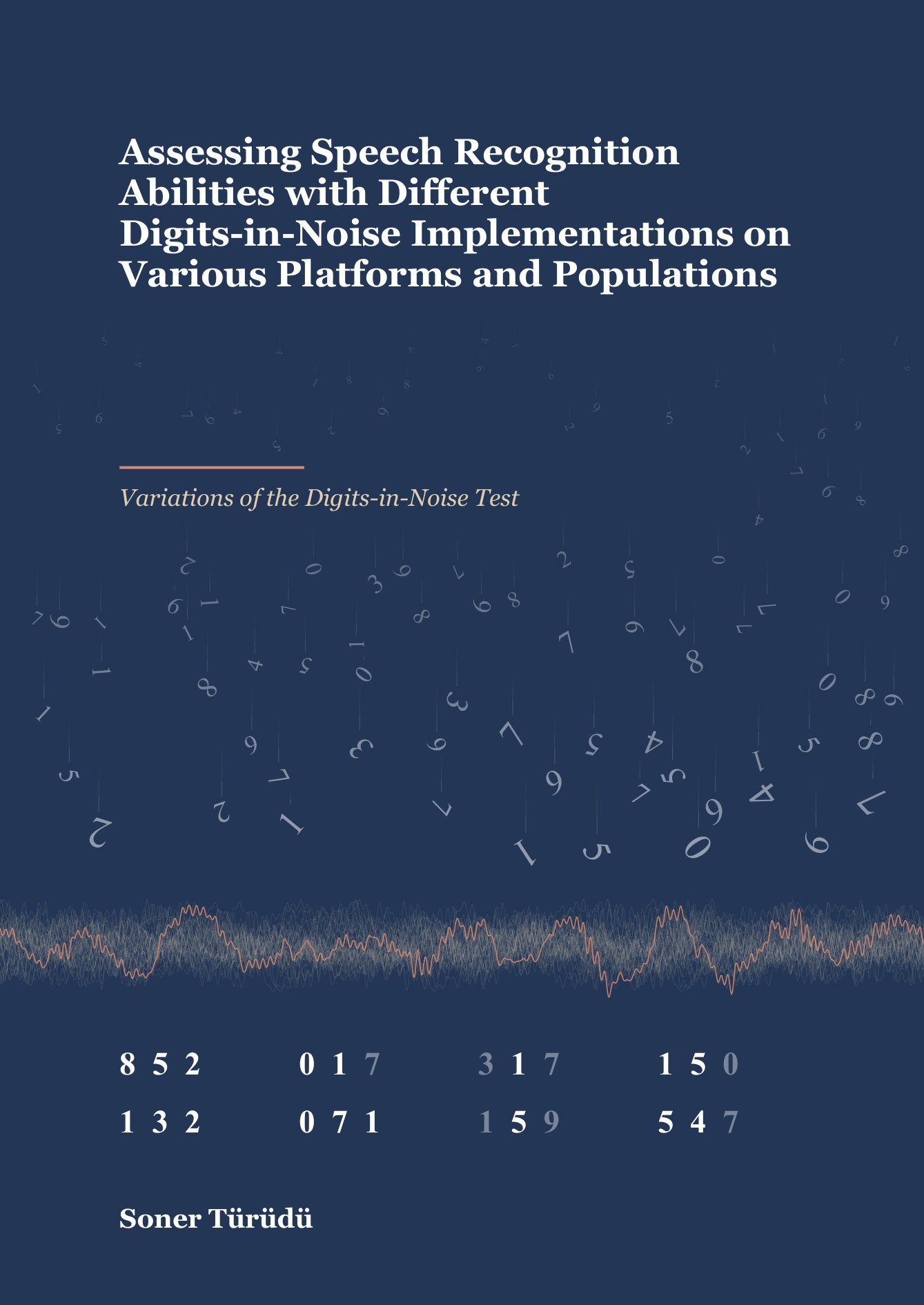
Soner Türüdü will defend his PhD Thesis “Assessing Speech Recognition Abilities with Different Digits-in-Noise Implementations on Various Platforms and Populations”.

Supervisors: Prof. dr. ir. Deniz Başkent and Dr. Thomas Koelewijn

Abstract
Many people hear well in a quiet room but struggle to follow a conversation in a busy café or on a train platform. A quick way to measure this is the digits-in-noise test: listeners hear three spoken digits in background noise and type them in, while the noise becomes louder or softer depending on their answers. The test takes only a few minutes, can be done online and has been translated into many languages. But because every version is built a little differently, results from different studies are not always comparable. In his PhD research, Soner Türüdü investigated how the digits-in-noise test can be described, compared and interpreted more clearly. He developed an open description that lets researchers report exactly how their version works, so that others can rebuild it. Using this description, he showed that an online version gives almost the same results as testing in the lab, and that the way the sound is played to the two ears affects the score most. He also developed a Turkish version and found that the choice of speaker has a small but measurable effect. Finally, he showed that Turkish native speakers living in the Netherlands the test seems more difficult in Dutch than in Turkish, and that their Dutch proficiency explains this best. These findings help clinicians and researchers use the test with care, also for people tested in a language that is not their own.

Ada Biçer will defend her PhD on 7 October 2026!

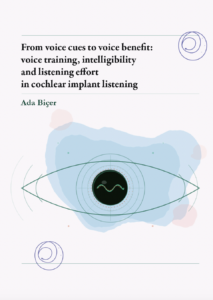
Ada Biçer will defend her PhD Thesis “From Voice Cues to Voice Benefit: Voice Training, Intelligibility and Listening Effort in Cochlear Implant Listening”.

Supervisors: Prof. dr. ir. Deniz Başkent and Dr. Thomas Koelewijn

Abstract
When we listen to someone speak, we do not only process the meaning of their words but also the uniqueness of their voice. Familiar voices like those of friends and family, seem easier to understand than unfamiliar voices, especially during a group conversation. What makes voices for us familiar and whether listening to familiar voices is less effortful remains unexplored, especially for cochlear implant (CI) users.

In my PhD research, I investigated whether voice training can improve speech understanding and ease the cognitive demands of listening, otherwise known as listening effort. Across three studies, results from both normal hearing listeners and CI users were assessed, using the pupil dilation response as an objective measure for listening effort. I found that voice training did reduce the effort required to understand speech. This effect was found for both normal hearing listeners and CI users, and across different voice training methods. Nevertheless, voice training did not lead to improvements in speech understanding.

These findings suggest that voice training can be beneficial at a cognitive level, which is not always reflected in behavioral outcomes. This is especially important for CI users, for whom everyday listening situations are generally experienced as effortful, which can lead to fatigue. Findings from these studies highlight the importance of measuring not just how well people understand speech, but also the cognitive cost associated with it. Future research can assess whether voice training could be incorporated into auditory rehabilitation.
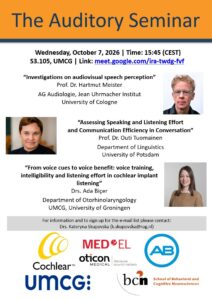
Auditory Seminar | October 7, 2026 | Prof. Dr. Hartmut Meister, Prof. Dr. Outi Tuomainen, Drs. Ada Biçer

Investigations on audiovisual speech perception
Prof. Dr. Hartmut Meister
AG Audiologie, Jean Uhrmacher Institut University of Cologne

Assessing Speaking and Listening Effort and Communication Efficiency in Conversation
Prof. Dr. Outi Tuomainen
Department of Linguistics, University of Potsdam

From voice cues to voice benefit: voice training, intelligibility and listening effort in cochlear implant listening
Drs. Ada Biçer
Department of Otorhinolaryngology, UMCG, University of Groningen

Wednesday, 7 October, 2026
15:45 (CEST)
S3.105, UMCG
Link for online participation: meet.google.com/ira-twdg-fvf
For information and to sign up for the email list, please contact drs. Kateryna Skupovska, k.skupovska@rug.nl

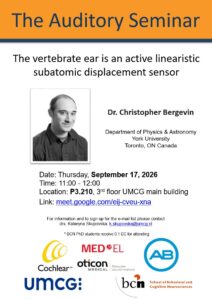
Auditory Seminar: Dr. Christopher Bergevin​ | 17 September, 2026

The vertebrate ear is an active linearistic subatomic displacement sensor​
Dr. Christopher Bergevin​

Department of Physics & Astronomy​, York University​, Toronto, ON, Canada​​​​

Thursday, 17 September 2026
11:00–12:00 h

Location: P3.210, 3rd floor UMCG main building

Link for online paricipation: meet.google.com/eij-cveu-xna

For information and to sign up for the email list, please contact drs. Kateryna Skupovska, k.skupovska@umcg.nl

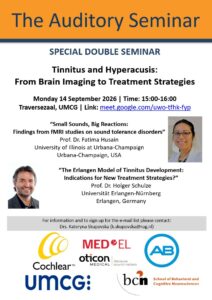
Special double seminar | Tinnitus and Hyperacusis: From Brain Imaging to Treatment Strategies | 14 September 2026

Small Sounds, Big Reactions: Findings from fMRI Studies on Sound Tolerance Disorders
Dr. Fatima Husain

Professor, University of Illinois Urbana-Champaign, USA

The Erlangen Model of Tinnitus Development: Indications for New Treatment Strategies?
Dr. Holger Schulze

Professor, Friedrich-Alexander-Universität Erlangen-Nürnberg, Germany

Monday, 14 September 2026
15:00–16:00 h

Traversezaal, UMCG

Link for online participation: meet.google.com/uwo-tfhk-fyp

For information and to sign up for the email list, please contact drs. Kateryna Skupovska, k.skupovska@umcg.nl