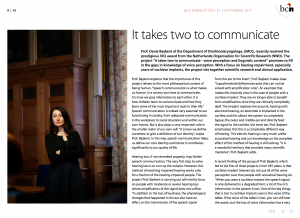
A very nice interview by Elouise Koops covers our new VICI grant in the BCN newsletter.
To read more please visit the BCN newsletter website.
A very nice interview by Elouise Koops covers our new VICI grant in the BCN newsletter.
To read more please visit the BCN newsletter website.
Terrin Tamati received a VENI Award from NWO. Below is a short summary of this new project. Congratulations!
More than words: Uncovering the effects of talkers’ voices on real-life speech perception by cochlear implant users
Dr. T.N. (Terrin) Tamati (f), UMCG – Department of Otorhinolaryngology
Understanding speech in the real world, outside the clinic, can be challenging. This project investigates cochlear implant users’ perception of speech produced by talkers with different voices and accents. Findings will identify difficulties cochlear implant users encounter in their daily lives, to account for them in clinical settings.
Our research and Sam van KNO were featured in Unifocus.
Anita’s submission “The role of timing in automatic processing of speech at sub-lexical and lexical levels”to 1st Conference of the Timing Research Forum is accepted as oral presentation. The work is on individual differences in speech processing mechanisms on cochlear-implant users. The link to the Forum itself here.

Foto: Henk Veenstra
Our new VICI project on voice and speech perception in normal and impaired hearing is featured at the UMCG newsletter Kennisinzicht. It covers all the highlights of what we want to do — how we want to understand both the basic science behind voice perception in relation to speech understanding and how we want to make use of this knowledge to help hearing-impaired individuals. The fun sub projects involve using Sam the robot for more efficient and fun testing and training.
For more details, the link to the KennisInzicht article is here.
Broadcasting link: https://tinyurl.com/27-06-2017-Auditory-Seminar
Dr. Robert Harris
Lifelong Learning in Music
Hanze University of Applied Sciences
Prince Claus Conservatoire
Broadcasting link: https://tinyurl.com/23-06-2017-Auditory-Seminar2
Dr. Lars Riecke
Department of Cognitive Neuroscience
Faculty of Psychology and Neuroscience
University of Maastricht
Speech entrainment, the alignment of neural activity to the slow temporal fluctuations (envelope) of acoustic speech input, is ubiquitous in current theories of speech processing. Associations between speech entrainment and acoustic speech signal, behavioral listening task, and speech intelligibility have been observed repeatedly. However, a methodological bottleneck has prevented clarifying whether speech entrainment functionally contributes to speech intelligibility. Here, we addressed this issue by experimentally manipulating speech entrainment in the absence of systematic acoustic and task-related changes with a novel approach that involves stimulating listeners with transcranial currents carrying speech-envelope information. Results from two experiments involving a cocktail party-like scenario and a listening situation devoid of acoustic envelope information show consistently an effect on listeners’ speech-recognition performance, demonstrating a causal role of speech entrainment for speech intelligibility. This finding supports entrainment-based theories of speech comprehension and suggests that transcranial stimulation with speech envelope-shaped currents can be utilized to modulate speech comprehension.
Jeanne Clarke’s submission, “Top-Down Repair of Interrupted Speech in Electro-Acoustic Stimulation,” co-authored with Etienne Gaudrain, is upgraded to a talk at CIAP 2017.
Congratulations Jeanne!
Nawal El Boghdady received a travel grant from CIAP 2017 organization. She will present our collaborative work with Waldo Nogueira and Florian Langner from Hannover Medical Center and co-funded by Advanced Bionics, “Improving speech perception in cocktail-party situations for cochlear implants.”
Leanne Nagels’s submission “Lexical access in cochlear implant users” to AMLaP 2017 is upgraded to a podium talk. The work was supervised by Dr. Anita Wagner and conducted in collaboration with Prof. Roelien Bastiaanse (Neurolinguistics). Congratulations!